Blog

Welcome to the Creative Results Management blog. 

Log in to be able to comment. Use "Help" if you need help logging in. If you don't have a log in, contact us and we'll give you one.
<< First  < Prev   1   2   Next >  Last >> 
  • 07 May 2012 3:34 PM | Keith Webb (Administrator)
    The goal of those working in non-profit organizations is to see lives changed. And that's difficult.

    When the going gets tough, many, quit. Oh, we don't say we're quitting. We simply change our strategy to something new and exciting. The trouble is we change before achieving the previous strategy.

    We lack endurance.

    The Apostle Paul illustrates endurance in the face of hardship with a soldier, an athlete, and a farmer (2 Timothy 2:3-6). Let me share five principles of going the distance.

    1. Focus develops talent
    Most so-called "natural talent" is actually years of focused hard work. Professional athletes have a singular focus - their sport. All the good, important, and interesting things that are not their sport are just distractions.

    2. Commit specifically
    General goals are too easily changed. Make a commitment to what you will specifically achieve no matter how long it takes.

    3. Learn from the best
    Half of all Nobel Laureates between 1901 and 1972 studied with or were mentored by other Nobel Laureates. Coincidence?

    4. The Ten-Year Rule of Creativity
    We greatly underestimate how long success will take. It takes an average of 10 years to gain the personal mastery needed to produce ground-breaking accomplishments.

    5. No excuses advisers
    When discouraged, the average person will hear our woes and sympathize with our desire to quit. What we need are those who won't except our excuses and will tell us to stop whining and keep moving forward.

    There are few microwavable versions of success. Most success is cooked up the old-fashioned way: good ingredients, hard work, and a long bake. Seeing lives changed will require nothing less than the same.

    How About You?
    • What good, important, or interesting things are distracting you from your true mission?
    • What is your commitment? How long will you commit for?
    • Who's the best at what you want to achieve and how can you learn from them?
    • Who will keep you from quitting too soon?
  • 05 Apr 2012 8:23 AM | Keith Webb (Administrator)
    Here's a list of reviews and mentions of the book. Purchase your copy here: From Amazon.com in Print or Kindle US or UK.   


    "I've read it - and I believe it presents an incredibly practical way to help others to become more aware of what God intends for them to do, and then to take steps to move forward to accomplish it."
    Dave DeVries, DMin
     4/5/2012

    "Keith Webb's The COACH Model is an excellent resource for those of us involved in coaching others. His approach is clear, simple, and easy to follow and provides a great set of tools to help us in serving, leading and shepherding. I heartily recommend this great resource!"
    Joseph W. Handley
    President - Asian Access
     
    “Keith Webb’s heart for coaching was born out of a passion to help leaders fulfill their calling. He is equally passionate about equipping others for the coaching role. The COACH Model for Christian Leaders is the fruit of Keith's years of experience in coaching and coach training. Keith is a master in his fieldundefinedthorough, professional, clear, and inspiring.”
    Steve Addison
    Author of Movements That Change the World
    Australian Director of Church Resource Ministries
     
    “I was introduced to The COACH Model at a workshop led by Dr. Keith E. Webb and can honestly say that it changed my approach to leadership and equipped me to more effectively develop other leaders. Since then I have enthusiastically used the approach and challenged others to do the same. I highly recommend this book.”
    Félix Ortiz
    Staff Care and Development Director of Agape Europe
    Coach, Author, and Leader Developer in Europe and Latin America
     
    "As a Christian coach, I coach both church leaders and business people in secular companies. I often suffer from Christianized secular coaching models that basically reduce the quality of the original method. This book is different. The COACH Model for Christian Leaders is state of the art from a professional perspective as well as a genuine Christian approach. It lays necessary foundations for the work of a coach and is a practical guide for all who want to coach and empower others to unfold their God-given potential."
    Christoph Schalk 
    Senior Coach of the Association of German Psychologists (BDP)
    CEO of NCD International
     
    "Keith Webb’s The COACH Model for Christian Leaders links coaching with ministry and real life experiences. Using stories as examples throughout the book, Keith shares coaching practices, skills and distinctions in a practical and useful way."
    Linda J. Miller, MCC
    Global Liaison for Coaching at The Ken Blanchard Companies
     
    "A superb and accessible blend of coaching theory and practice, this book will, if implemented, make a huge impact in your organization. Keith’s extensive and varied cross-cultural experience, coupled with his insights into human nature, and his grounded approach have produced a powerful book that will enable Christian leaders to lift their ministry to significantly higher levels of effectiveness. I highly recommend this book for leaders of Christian organizations."
    Rev Peter R. Smith
    Field Ministries Director
    World Outreach International
     
    "The complexity of leading multicultural teams has forced Christian leaders around the world to realize they need more diverse tools than those with which they started their journey. Keith Webb’s groundbreaking Core Coaching Skills Certificate Program has already infected thousands globally with a fresh approach to leading and supervising team members. The COACH Model for Christian Leaders completes a leader’s toolkit with an easily transportable, culturally transferable approach to indirect leadership that has proven workable in dozens of cultures. This book will improve your influence capacity, and increase your leadership effectiveness by expanding your range of leader practices."
    Steve Hoke, PhD
    Co-author of The Global Mission Handbook
     
    "Dr. Webb has done a terrific job in making coaching practices understandable and accessible. I especially appreciate the portable nature of the COACH model. You can learn and remember the core parts readily and then take it wherever you go. I have already started using some of Keith’s suggestions, such as simply checking in with people to see how they are doing and what they are wanting, informally among friends and colleagues or more formally as part of my work. Keith also does a brilliant job weaving together examples, dialogues, comments, principles, and quotes. Further, his self-disclosures and personal writing style set the tone for others to do likewise - to be curious about how they think and act and then to add the personal element of themselves as they connect with others. This book is highly readable and highly relevant for people at all levels who want to further develop their interpersonal and coaching skills. I highly recommended it!"
    Dr. Kelly O’Donnell
    CEO Member Care Associates, Inc. 
  • 04 Apr 2012 9:32 AM | Keith Webb (Administrator)
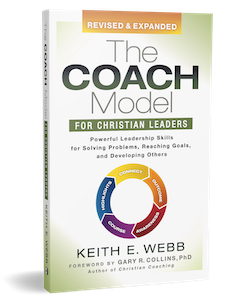
    An excerpt from The COACH Model for Christian Leaders by Keith E. Webb

    To coach well, it is helpful to distinguish between Process and Content. The Content of a coaching conversation includes the topic of the conversation, facts, information, ideas, and commitments. The Process includes how the coach and coachee go about discussing and working with the Content.

    The responsibility for Process and Content is not equally divided in coaching. This lack of balance is not typical of other types conversations-and this is what makes coaching so powerful. In a friendship conversation Content is provided by each individual in a fairly balanced manner-each person shares his or her stories, ideas, suggestions, and advice. If you are in a teaching role, you may be responsible for both the Process and Content.


    The coach does not provide Content: the information, ideas, or recommendations. In coaching, the coach focuses almost entirely on the Process, drawing out nearly all the Content from within the coachee.


    Content & Process  


    Notice the verbs at the beginning of each Process statement. Process is mostly about atmosphere and conversation dynamics. The coach is largely responsible for the Process. All of the Process is directed toward helping the coachee make discoveries, find solutions, and move forward in terms of understanding and action. As a coach focuses on Process the coachee will find his or her own answers.


    The power of coaching is in the Process. A coach empowers others by helping them to self-discover, gain clarity and awareness, as well as by drawing Content from them. A good coach helps draw out what the Holy Spirit has put in.  


    What About You?
    • In your coaching, how much Content do you provide?
    • Which of the Process skills would you like to further develop?
  • 12 Mar 2012 7:53 AM | Keith Webb (Administrator)
    Everyone in town knew that the pool at Bethesda had healing powers. When an angel stirred the waters, the first person to enter the pool would be healed. The man Jesus met there, had been waiting for thirty-eight years. Jesus asked about the man's real goal, "Do you want to get well?" 

    It is instructive to consider the man's response. "Sir," the invalid replied, "I have no one to help me into the pool when the water is stirred. While I am trying to get in, someone else goes down ahead of me." 

    The man at the pool fell into a common thinking pattern that makes it harder to reach our real goals. His thought was, "in order to be healed I must get into the pool first."  Was this the only option? No, but the man thought it was and looked for help to achieve it. 

    This story highlights the difference between a goal and steps to achieve a goal. Jesus asked about the goal. The man replied with a step to achieve the goal. The story continues with Jesus healing the man, thus achieving his real goal without first accomplishing the other steps. 

    In coaching, it's easy to take the first thing the coachee says and believe that is the goal. Take some time during the Outcome-setting stage to distinguish between the goal and the steps to achieve the goal. One way to do this is to spot the "in order to ... I must..." pattern. The coachee might not use exactly this phrasing, but the meaning is there. Here are some examples:
    • "In order to change things in this organization I must be be the leader."
    • "In order to be effective in ministry I must be fluent in the local language."
    • "In order to be a good mother I must make dinner every night."
    Identifying the real goal helps to clarify purpose and motivations, determines if the step to the goal is even needed, and may present other better options to reaching the goal. 

    Questions
    • What do you hope to achieve by accomplishing this?
    • What's the bigger goal behind this goal?
    • What's the end result you are after?
    Join the discussion, leave a comment below.
  • 13 Feb 2012 8:00 PM | Keith Webb (Administrator)
    Traditionally, what a person learned as a young adult would serve them in their profession the rest of their lives. This is no longer true.

    "What individuals have learned by age twenty-one," wrote Peter Drucker, "will begin to become obsolete five to ten years later and will have to be replaced - or at least refurbished - by new learning, new skills, new knowledge." How much more so by age 31, 41, or 51!

    The world is becoming more complex by the day. Change is everywhere and relentless.
    • That "high-tech" website of five years ago is a dinosaur today.
    • The skills to lead a team have changed significantly with the increase in virtual teams.
    • The directive style we admired in leaders of yesterday is now considered disempowering.
    What do we do? Keep learning!

    The past 8 years, I have been on a journey in retooling of my work, communication skills, and leadership style. And I know there is nothing but more change ahead of me. Three things have helped.

    Accept Change
    Embrace the fact that 80% of how you are doing things now will change in the next 10 years, perhaps change several times. Values and meaning will continue throughout but using different forms.

    Learn As You Go
    You most likely don't need a formal degree, just continued learning. Many professions require 40 hours of continuing education every year or so to maintain a credential. It's a good number to shoot for. Attend a conference, a workshop, or a training event. Don't dabble with a 1/2 day or 1 day training, take enough to really learn it.

    Get Coaching
    Coaching is extremely helpful in seeing new perspectives on old problems and getting into action in new ways. A large part of coaching is in helping people to find ways to learn what they need to move forward.

    How About You?
    • What do you need to "retool" in your leadership style?
    • What's one place you are settling for "good enough" rather than excellence in your work?
    • Where will you look to find the help you need to move forward?
  • 10 Jan 2012 5:00 AM | Keith Webb (Administrator)
    The magazine Business Week asked 2,000 managers and executives, "Are you one of the top 10% of performers in your company?" The poll found that overall 90% of workers answered yes! That impossible number of "yes" responses came from 89% of females, 91% of males and a whopping 97% of executives. (Source: Business Week Aug 20, 2007 p. 49)

    What’s happening here? Sociologists identify an inflated view of oneself as a result of "self-enhancement." Taking many forms, self-enhancement is an exaggerated assessment of our strengths, capabilities, and contributions. We use it to protect our self-image. We focus on our positives contributions and our strengths, downplaying or ignoring our negative behavior and weaknesses. 

    Self-enhancement can cause us to believe that we can magically move our thoughts into action.

    Richard, a soon-to-be church planter in Italy, needed an immigration visa. I asked him about the process, visa requirements, and time frame. He brushed off the questions with, "No problem, I’ve got my doctorate and a local sponsor. I won't have any trouble with the Italian government."

    It turned out that the Italian government did not have a sign reading "All Who Have Doctorates, Welcome to Italy!" Instead, they required mountains of paperwork to prove very high standards and required months to process the visa. Richard greatly overestimated his ease of moving through the Italian immigration process.

    One result of self-enhancement is a tendency to over-estimate what we can do, both in terms of our ability to accomplish the task and how quickly we can do it. Sometimes coachees can be naive or overambitious when setting action steps. Coaching can help.

    While each action step is 100% up to the coachee to decide, through dialogue the coach can ask clarifying questions regarding what the action step will look like, how it will be done, and realistic timing. Good coaching provides a helpful balance to over-estimations caused by self-enhancement.

    Coaching Questions
    • How will you go about doing this action step?
    • What problems may emerge as you move forward?
    • What help or "buy-in" do you need from others?
  • 16 Dec 2011 6:26 PM | Keith Webb (Administrator)
    Jesus described leadership as serving people rather than lording over them (Matthew 20:25-28). Service, rather than control, distinguishes this way of leading.

    In Jesus' day as well as ours, leaders, because of their authority can determine the direction of the organization and assign tasks. Those leaders who assign tasks arbitrarily or for their own personal gain "lord over" their followers rather than serve them.

    Getting things done is important. An organization must achieve its objectives, be they related to impact or finance. How leaders reach objectives is the key to servant leadership. This is where a coaching style of leading intersects with servant leadership. 
     
    Coaching and Servant Leadership
    1. Lead with influence rather than position. Dr. J Robert Clinton, a Christian leadership professor, defines leadership as influence. Everyone has influence, the question is, how is that influence used? Those with leadership positions can use that position to "force" others, rather than finding ways to draw out natural motivations.

    2. Lead with respect rather than control. A coaching style gives up 100% control (or the illusion of it) and empowers those around him by listening, asking questions, and allowing a degree of freedom for decision-making. This demonstrates respect for others, which engenders trust from followers.

    3. Lead with growth rather than utility. Servant leaders and coaches develop others. They don't just use people to achieve tasks. They simultaneously encourage the growth of those they work with while at the same time achieving the organization's objectives.

    Leading with influence, respect, and growth are traits of a servant leader. A coaching mindset and skills will help a leader to act in these ways.

    How About You?
    • Where do you find your authority reliant on position? What could you do to shift to influence and relationship as your authority base?
    • How could you increase listening, asking questions, and allowing others to make decisions for themselves?
    • Ask staff how they want to grow while achieving work objectives. Create growth goals along side each work objective.
  • 07 Nov 2011 1:00 PM | Keith Webb (Administrator)
    In learning to coach others, it is far easier to learn and practice skills like listening or asking questions, than it is to learn qualities such as curiosity. Yet, curiosity is essential to listening and asking questions. 

    Curiosity opens new thoughts and perspectives. Curiosity asks why things are the way they are and not some other way. Curiosity looks for what it doesn't know rather than seeking to confirm what it does. 

    How To Cultivate Curiosity

    1. Cultivate your whole brain. Curiosity is more a function of the artistic right side of our brains, than the logical left side. Expand your listening beyond logical cause-and-effect. Listen in pictures with colors and imagination. 

    2. Expand your interests. Breadth and diversity are the foundations of curiosity. Read the whole newspaper, not just your favorite section. Read fiction. Turn off sitcoms and watch Discovery Channel, National Geographic, and the BBC. Take a course completely unrelated to your work. 

    3. Be childlike. Children know they don't know and ask. Their questions ask about basic assumptions and unspoken details. They learn and their world expands. But somewhere in adolescence they stop asking and by their late-teens many feel they know everything. 

    4. Ask, even if you think you know. Although, watch your motivations. If you ask to confirm what you think you know you will focus on responses that agree. Instead, ask to expand your perspective and look for responses that are different in some way than you expected. 

    Curiosity requires an attention to detail and nuance that can be cultivated by expanding our interests and perspectives. Curiosity leads to innovation and good coaching.

    How About You?
    • As you listen make leaps of thought beyond logic, asking: What if...? and Why not...? 
    • How will you add diversity to your media intake today?
    • Examine your motives as you ask questions: Are you confirming your assumptions or expecting to learn?
  • 06 Oct 2011 9:21 AM | Keith Webb (Administrator)
    "Would you like oatmeal or yogurt and toast for breakfast?" a mother asks her 5 year old. 

    "I'll have sugar frosties," the child answers. 

    Mom replies, "Your choices are oatmeal or yogurt and toast." 

    "Ok, I'll just have yogurt and toast."

    Notice how Mom's question limits the girl's breakfast choices. Why does she ask it that way? Because otherwise the child might eat sugar frosties every morning! 

    This story illustrates the subtle ways that we use questions to control a conversation and limit choices for the other person. For a child this may be the proper thing to do. However, if you listen carefully to yourself and others, we do the same thing all day long. And we may not even be aware we are doing it. 

    Limited Choices
    "Would you like to go to a movie tonight?"
    "Do you think Emma or Daniel could help you?"
    "Are you working on your class preparation this afternoon?" 

    Closed questions, right? So open them up and get your limiting ideas out of the way: 

    "What would you like to do tonight?"
    "Who could help you?"
    "When will you do your class preparation?"

    Guard Rails
    We put up "guard rails" to keep the other person within the boundaries that we consider to be logical, effective, or "safe." For example, rather than asking questions about completely starting a project over, we ask questions about only incremental changes. Or visa-versa. 

    Consciously or unconsciously our thinking, our ideas, our trust of the other person leaks into our questions. When we put up "guard rails" we try to steer others in the direction we want them to go. How much do you trust people to choose their own path and put forward their own choices?

    Our questions have the power to expand the other person's thinking, or limit it.

    How About You?
    • Listen to your questions today. Are you limiting choices?
    • What "guard rails" are you using with other people? 
    • Look for opportunities to "trust" others more in your conversations. See what happens! 
  • 21 Sep 2011 10:04 AM | Keith Webb (Administrator)
    We all need to "market" ourselves to some extent, even if your focus is your own staff members. Here is a common list of marketing activities, in order of effectiveness.
    1. Direct contact and follow-up
    2. Networking and referral-building (in-person, personal email, etc)
    3. Public speaking (speech, seminar, workshop)
    4. Writing and publicity (blog, newsletter, articles, book)
    5. Promotional events 
    6. Website or advertising

    Expand your network by doing the more of the first 3 things. Add a short value-added monthly newsletter on your niche to supplement. Your newsletter keeps you in touch with people until they need you, plus they will pass it along to others. You can write a 2 paragraph newsletter with a short story and one thought only. Make it from your heart. People will love it.

    Don't sell coaching, sell the result. Focus your offerings on the results of coaching, be specific. Coaching is how you get that result. People buy results, not process.  For example: 
    • Communicating with Your Team
    • Thriving As an Expat
    • Parenting in Tough Times
    • Heading "Home": Surviving the Transition to Your Passport Country

    Don't be generic, be really specific (Personal Development is too general). Describe it like you would a workshop or training. You are not a life coach, you are Parent Communication Coach, or an Expat Transitions Coach. Are you getting the idea?

    Add a comment with what your results-focus name would be. I'm a                          Coach.
<< First  < Prev   1   2   Next >  Last >> 
 

Creative Results Management
Office hours: Monday - Thursday 9am to 5pm (Pacific time)
© 2012 Creative Results Management. All Rights Reserved. Contact Us